Meta Ads Creative Diversification: 7 Ways to Feed Andromeda (Without Wasting Budget on More Ads)
TL;DR: Meta ads creative diversification means giving Andromeda genuinely different formats, visuals, and text that target distinct customer personas. Most advertisers hear “diversify your creative” and flood their ad sets with 30+ similar variations. The real play is 7 specific types of creative diversity where quality and distinctness matter MORE than volume.
In This Post You’ll Learn
- Why “more ads” is the wrong response to Andromeda’s creative demands
- How Andromeda’s retrieval system matches creative to personas (and why similarity kills reach)
- The 4 pillars of true creative diversification: format, visual, text, and persona
- 7 specific ways to generate genuinely diverse creative for your Meta campaigns
- The quality vs. volume framework that separates profitable accounts from wasteful ones
- A 5-step audit to diversify your existing creative starting today
Why Most Advertisers Get Creative Diversification Completely Wrong
Everyone in the Meta ads space is talking about creative diversification right now.
And almost everyone is misinterpreting it.
Here is the misconception: advertisers hear “Andromeda needs diverse creative” and immediately start cranking out more ads. Ten variations of the same static image with different headline text. Twenty versions of the same UGC video with slightly different intros. Forty “unique” ads that are really just four concepts wearing different outfits.
That is creative volume, and Andromeda treats it accordingly.
Meta’s Andromeda system processes billions of ad candidates to find the right match for each individual user. When your “diverse” creative is actually 15 subtle variations of the same concept, Andromeda sees them as effectively identical. Your ads compete against each other for the same audience segments. Your costs go up. Your reach stays flat.
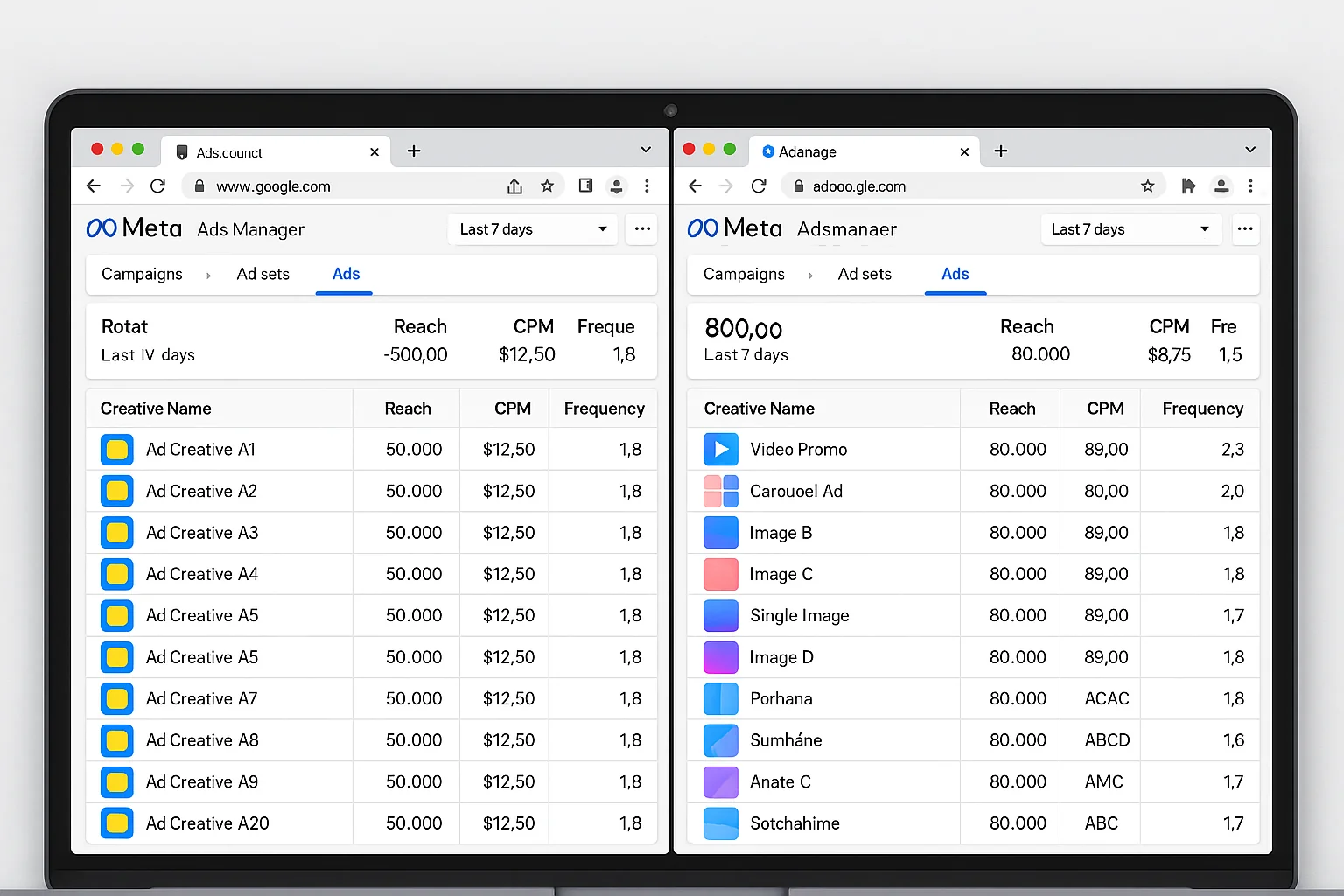
The practitioners who are winning right now understand something fundamental. Creative diversification is a strategy rooted in genuine difference, not a production quota.
The takeaway: If your “diversification strategy” means producing more of the same thing, you are actively working against Andromeda’s matching system.
What Meta Andromeda Actually Wants From Your Creative
Andromeda is Meta’s AI-powered ad retrieval model. It replaced the older auction-based delivery system with something far more sophisticated.
Here is how it works at a high level.
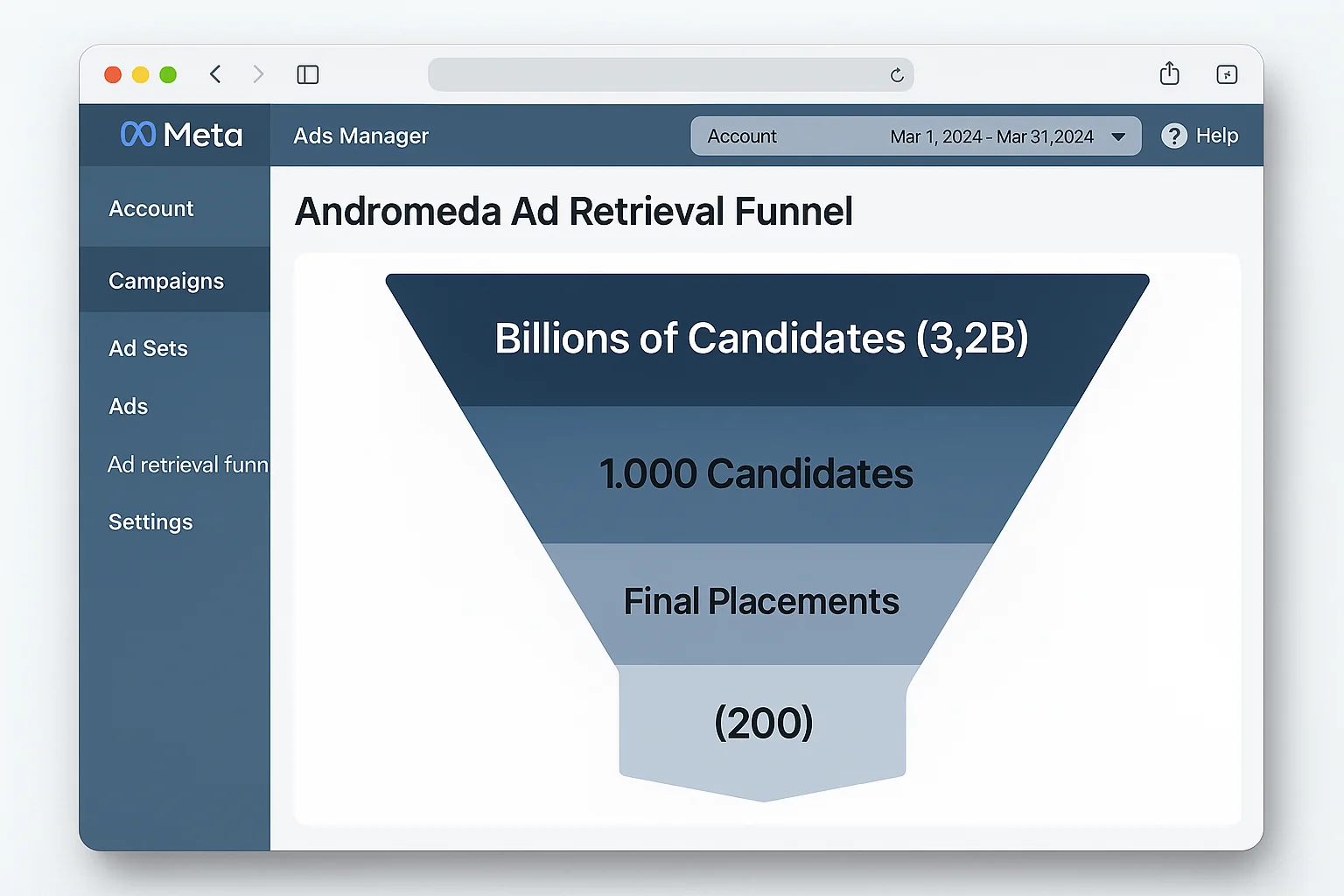
When a user opens Facebook or Instagram, Andromeda scans billions of ad candidates and narrows them down to roughly 1,000 relevant options in milliseconds. From there, a secondary ranking system selects the final ads that appear in the user’s feed.
The critical insight: Andromeda is trying to match specific creative to specific people. It evaluates not just targeting parameters but the creative itself, the format, the imagery, the text, the overall “feel” of the ad.
This means your creative IS your targeting now.
If all your ads look and sound the same, you are telling Andromeda to show your message to ONE type of person. You are voluntarily shrinking your addressable audience to a sliver of its potential.
According to Meta’s official documentation on creative diversification, creative similarity now directly impacts reach, cost, and ad fatigue. The system rewards advertisers who provide genuinely distinct options because those options unlock genuinely distinct audience segments.
Think about your own customer base. You have impulse buyers and careful researchers. You have 22-year-olds scrolling Instagram Reels and 48-year-olds browsing Facebook Marketplace. You have people who respond to bold claims and people who respond to social proof.
One creative style cannot reach all of them. Andromeda knows this. The question is whether your ad account reflects it.
The takeaway: Andromeda uses your creative to find the right audience. If your creative lacks diversity, you are capping your own reach before the algorithm even gets to work.
The 4 Pillars of True Creative Diversification
Creative diversification breaks down into four distinct categories. You need variation across ALL of them, not just one.
Pillar 1: Format Diversity
This is the most obvious layer. You need to be running static images, videos, and carousels. Not just one format, and not just two.
Each format reaches different users in different contexts. A static image stops the scroll differently than a 15-second video. A carousel creates interaction and dwell time that neither statics nor videos can replicate.
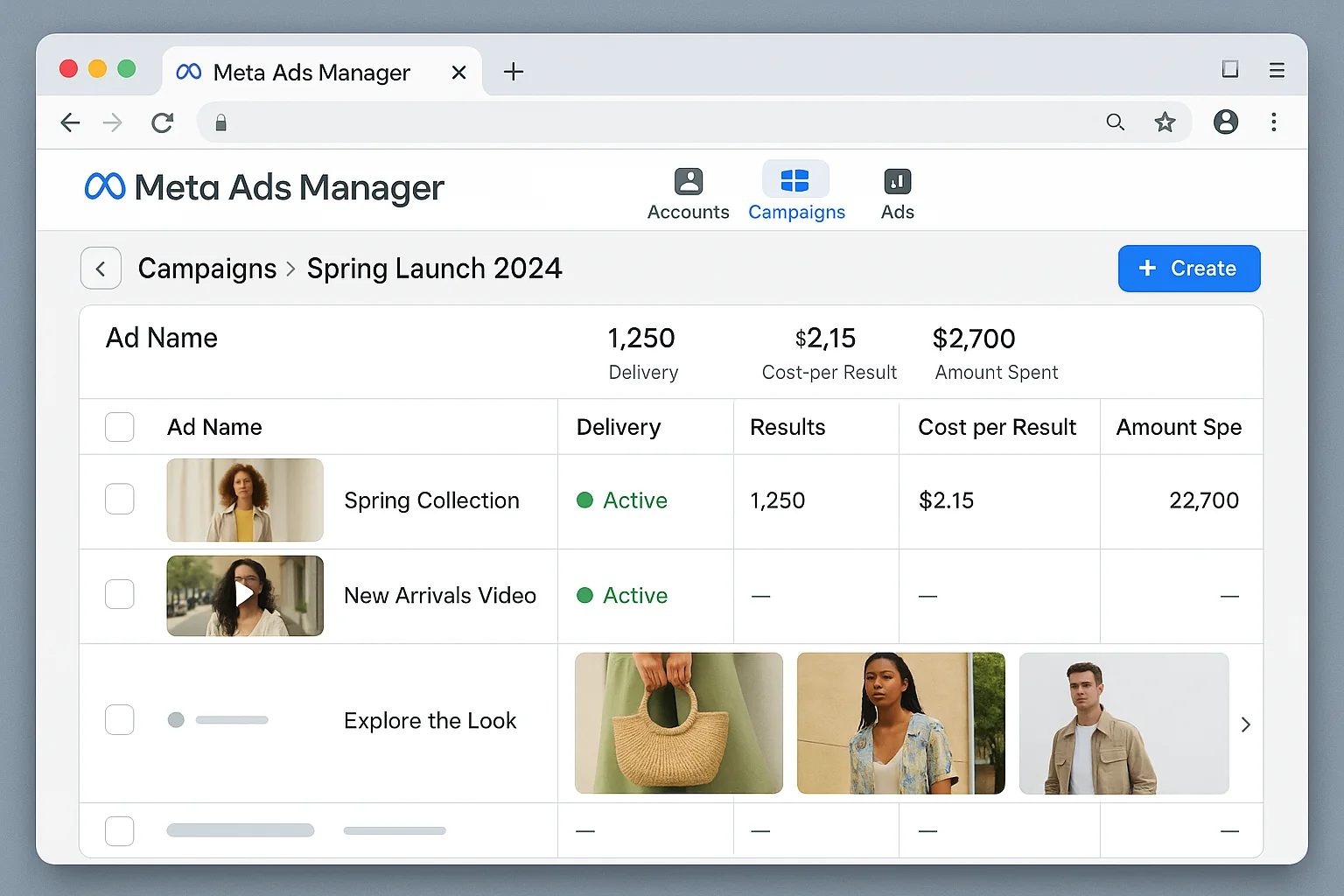
According to Meta’s creative differentiation guide, combining formats within the same ad set gives Andromeda more options to match the right creative type to each user’s consumption behavior.
Pillar 2: Visual Diversity
This is where most advertisers fall short. Visual diversity means your ads should look DISTINCTLY different from each other at a glance.
Changing the background color from blue to teal is not visual diversity. Swapping the product photo from angle A to angle B is not visual diversity.
Real visual diversity means:
- Product-focused shots vs. lifestyle imagery vs. UGC-style content
- Clean, polished studio visuals vs. raw, phone-shot authenticity
- Text-overlay graphics vs. pure imagery with no text
- Bright, high-contrast color palettes vs. muted, editorial tones
The test is simple. Put all your ads in a grid. If a stranger could tell they all came from the same brand in under two seconds, you lack visual diversity.
Pillar 3: Text Diversity
Your ad copy needs to be just as diverse as your visuals. Different text options should speak to different motivations, pain points, and stages of awareness.
A short, punchy headline (“Free shipping. Today only.”) targets a different decision-making style than a long-form story about how the product changed someone’s life.
Meta specifically recommends using unique text for each ad, with significant differences between them. Subtle word swaps do not count.
Pillar 4: Persona Targeting
This is the pillar that ties everything together.
Every format choice, visual direction, and text approach should map back to a specific customer persona. Your 22-year-old impulse buyer and your 45-year-old comparison shopper will respond to completely different creative.
When you diversify across all four pillars WITH persona intent, you are giving Andromeda a toolbox full of purpose-built instruments instead of a drawer full of identical hammers.
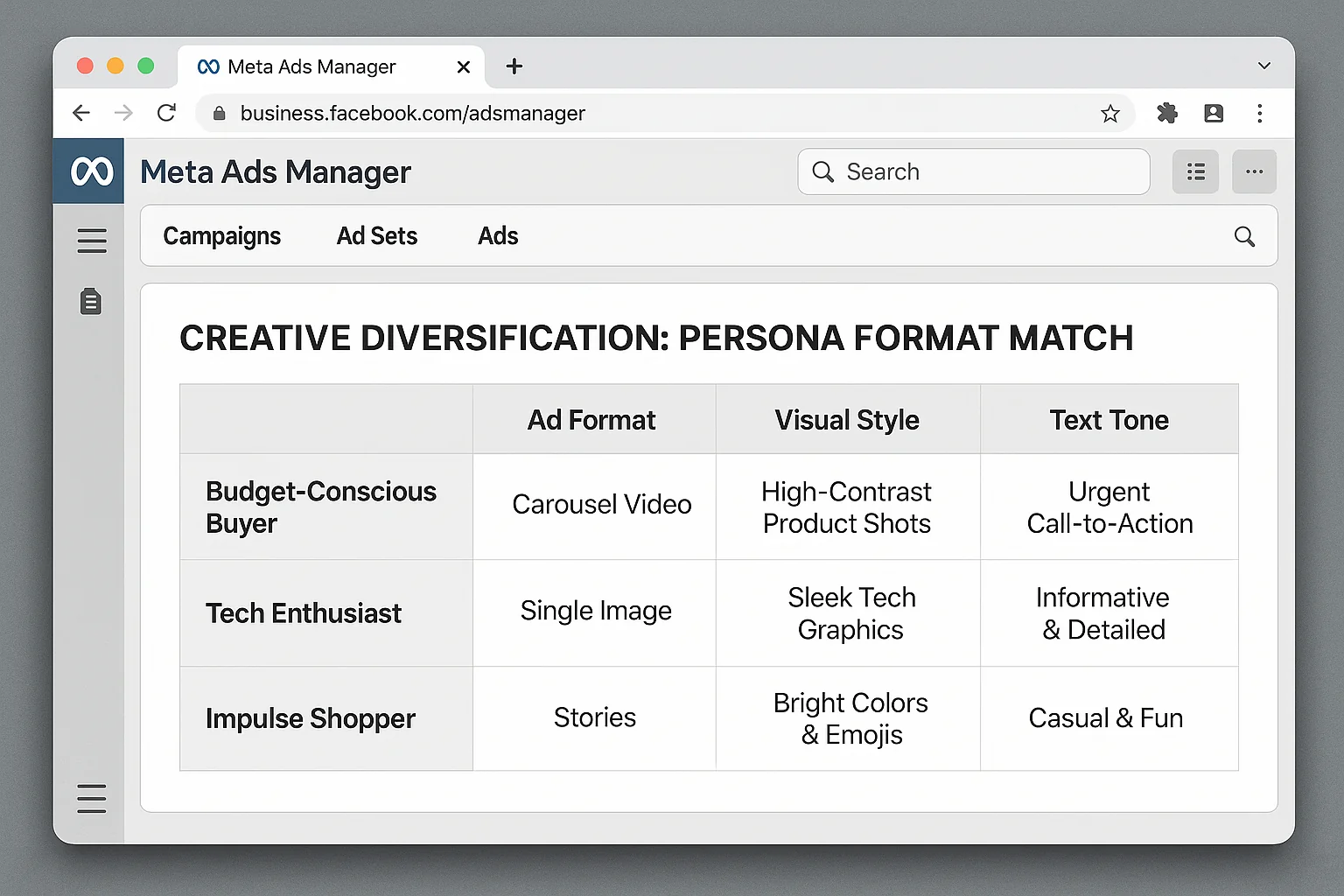
The takeaway: True diversification spans format, visual, text, and persona. Missing any single pillar limits Andromeda’s ability to find your full addressable audience.
7 Ways to Generate GENUINELY Diverse Creative for Meta Ads
Here is the framework. Seven specific approaches to building a creative library that Andromeda can actually use.
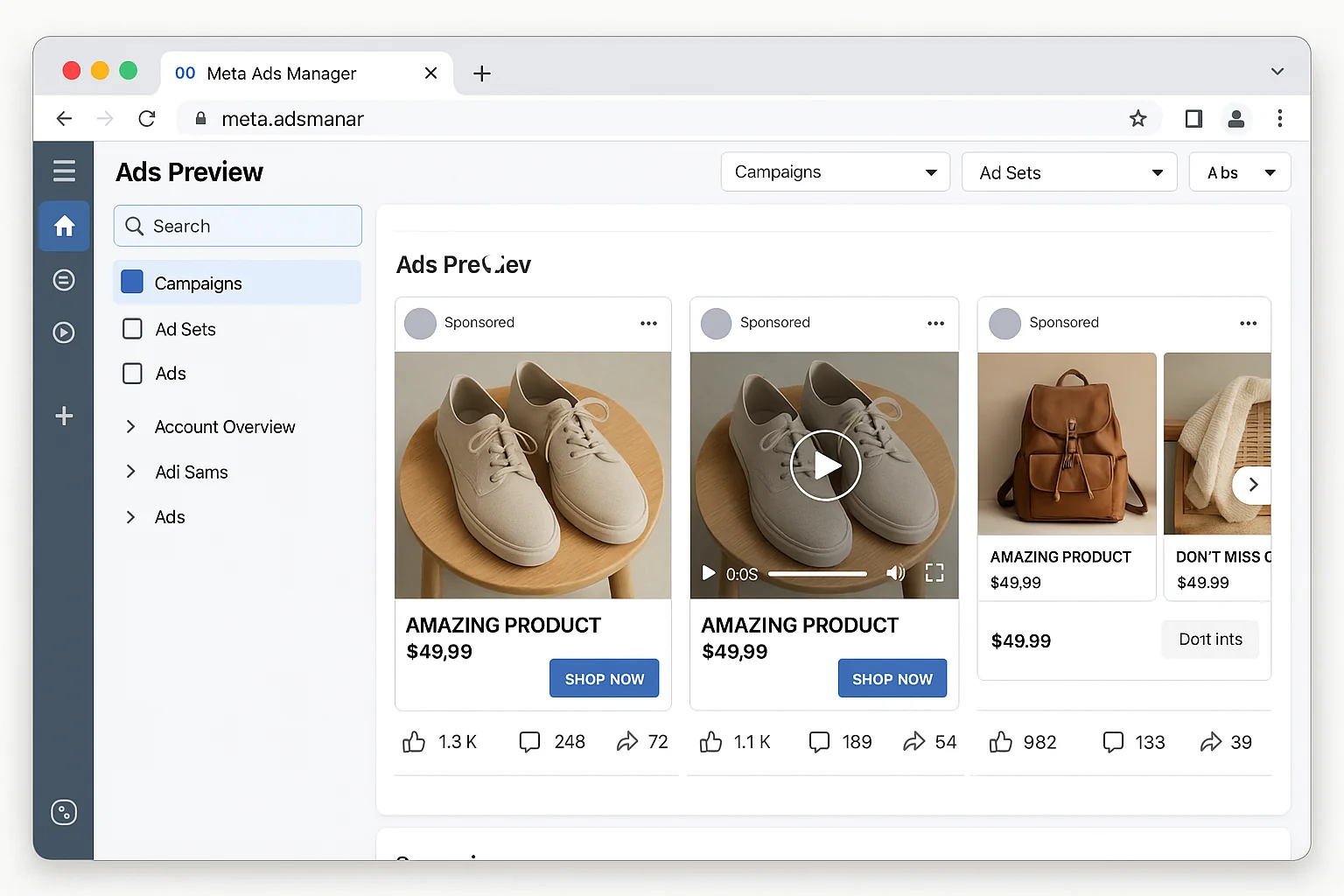
Way #1: Mix Your Formats (Static, Video, Carousel)
Start with the foundation. Every campaign should include at least one static image, one video, and one carousel. This is non-negotiable.
Statics work for quick, high-impact messaging. Videos work for storytelling and demonstration. Carousels work for product education, multi-feature breakdowns, and sequential narratives.
If you are running only one format, you are leaving entire audience segments untouched.
Way #2: Vary Your Visual Concept (Not Just Your Visual Treatment)
This goes beyond “same photo, different crop.” You need fundamentally different visual concepts.
For an ecommerce brand selling running shoes, this means:
- A studio product shot on white background (feature-focused)
- A runner mid-stride on a trail (lifestyle)
- A customer’s unboxing video recorded on their phone (UGC)
- A text-heavy graphic comparing your shoe to the competition (educational)
Four ads. Four completely different visual approaches. Andromeda will show each one to a different segment of your audience.
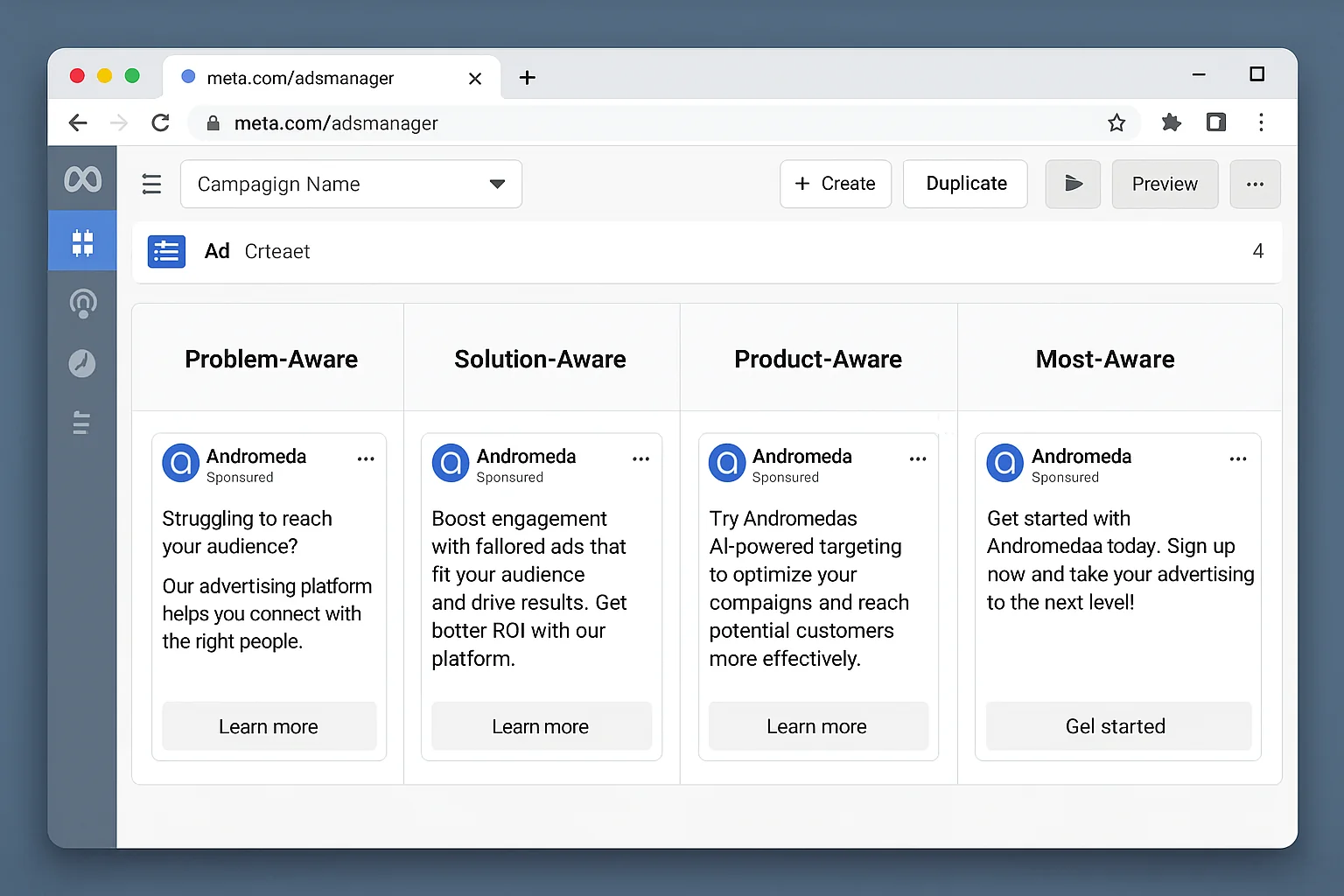
Way #3: Write for Different Awareness Levels
Your text should address people at different stages of the buying journey.
- Problem-aware text: “Still dealing with knee pain after your morning run?” (identifies the problem)
- Solution-aware text: “Cushioned running shoes that absorb 40% more impact.” (presents the category solution)
- Product-aware text: “The CloudRunner X has 2,847 five-star reviews for a reason.” (sells the specific product)
- Most-aware text: “Your CloudRunners are waiting. Free shipping ends tonight.” (closes the deal)
These four text approaches will reach four different audience segments through Andromeda’s matching.
Way #4: Create for Different Emotional Triggers
Some people buy based on logic. Some buy based on emotion. Some buy based on social proof. Your creative should cover all three.
- Logic trigger: Feature breakdowns, comparison charts, technical specs
- Emotion trigger: Transformation stories, aspirational lifestyle imagery, before-and-after narratives
- Social proof trigger: Reviews, testimonials, influencer endorsements, “best-seller” badges
Each trigger type appeals to a fundamentally different decision-making process. Research from HubSpot’s ad creative benchmarks consistently shows that accounts testing across multiple emotional triggers see higher engagement rates and lower cost-per-acquisition than single-angle accounts.
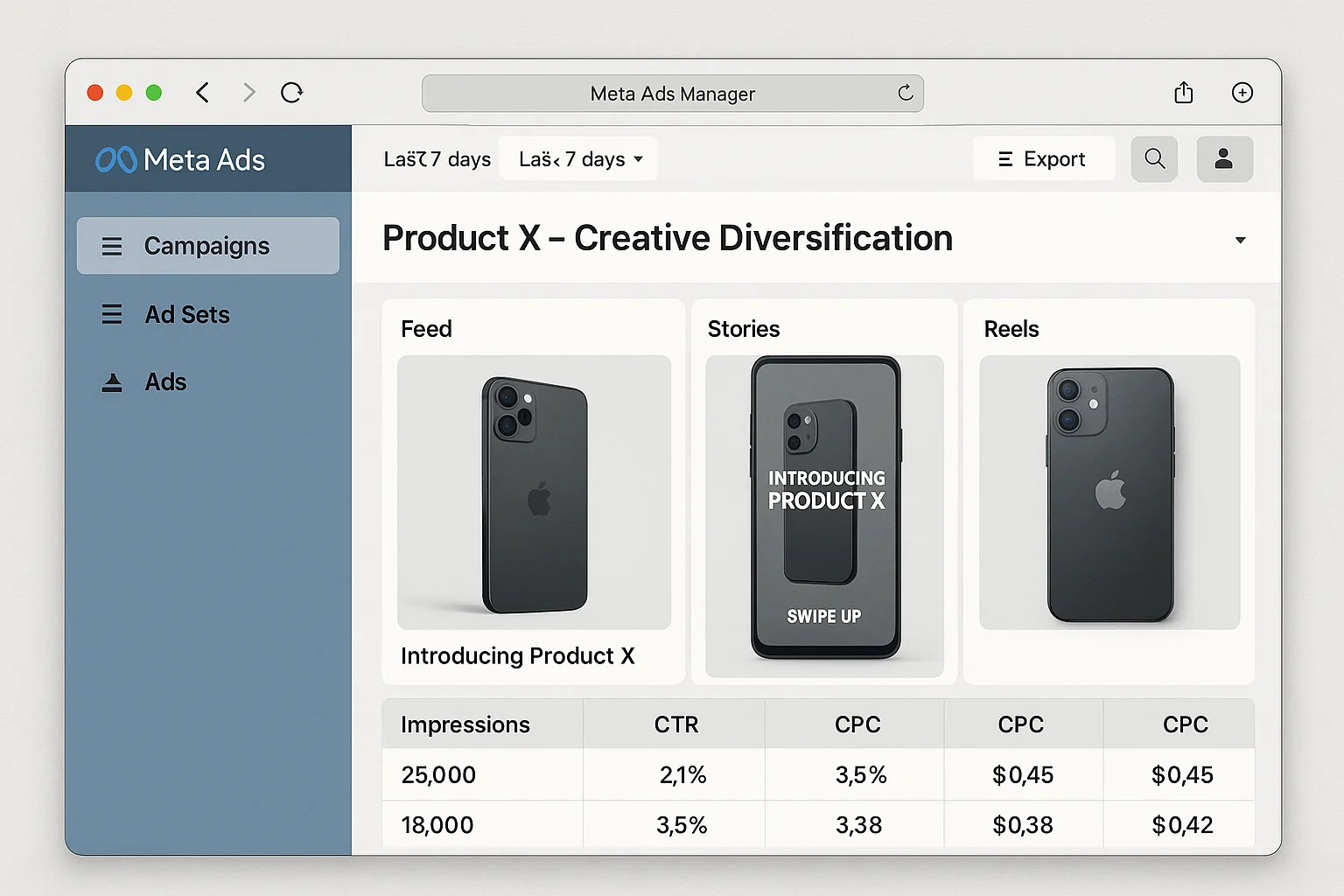
Way #5: Adapt Creative for Placement Context
A 9:16 vertical video that dominates on Instagram Stories will fall flat in the Facebook News Feed. A detailed carousel that performs in the Feed gets ignored in Reels.
Build creative specifically for each major placement:
- Feed (1:1 or 4:5 ratio, can handle more text)
- Stories/Reels (9:16, fast hooks, minimal text overlay)
- Right column (small format, high-contrast visuals, short headlines)
This is a form of diversification most advertisers skip entirely. They let Advantage+ placements do the work and serve the same asset everywhere. That is a missed opportunity.
Way #6: Test Different Creative Structures
Video ads alone can be diversified through structure:
- Hook-problem-solution: Open with an attention grab, present the pain point, reveal the product
- Testimonial walkthrough: A real customer explaining their experience in 15 seconds
- Product demo: No talking head, just the product in action with text overlays
- Listicle format: “3 reasons our customers never go back to [competitor category]”
Each structure creates a different viewing experience and holds attention for different personality types.
Way #7: Rotate Your Value Propositions
Most advertisers default to one core value proposition across all their creative. “Best price.” Or “highest quality.” Or “fastest shipping.”
Rotate through different angles:
- Price/value (“$39 for shoes that outlast $120 competitors”)
- Convenience (“Delivered to your door in 48 hours”)
- Social proof (“Join 50,000+ runners who made the switch”)
- Exclusivity (“Limited drop. 200 pairs left.”)
- Guarantee (“Try them for 30 days. Full refund if you hate them.”)
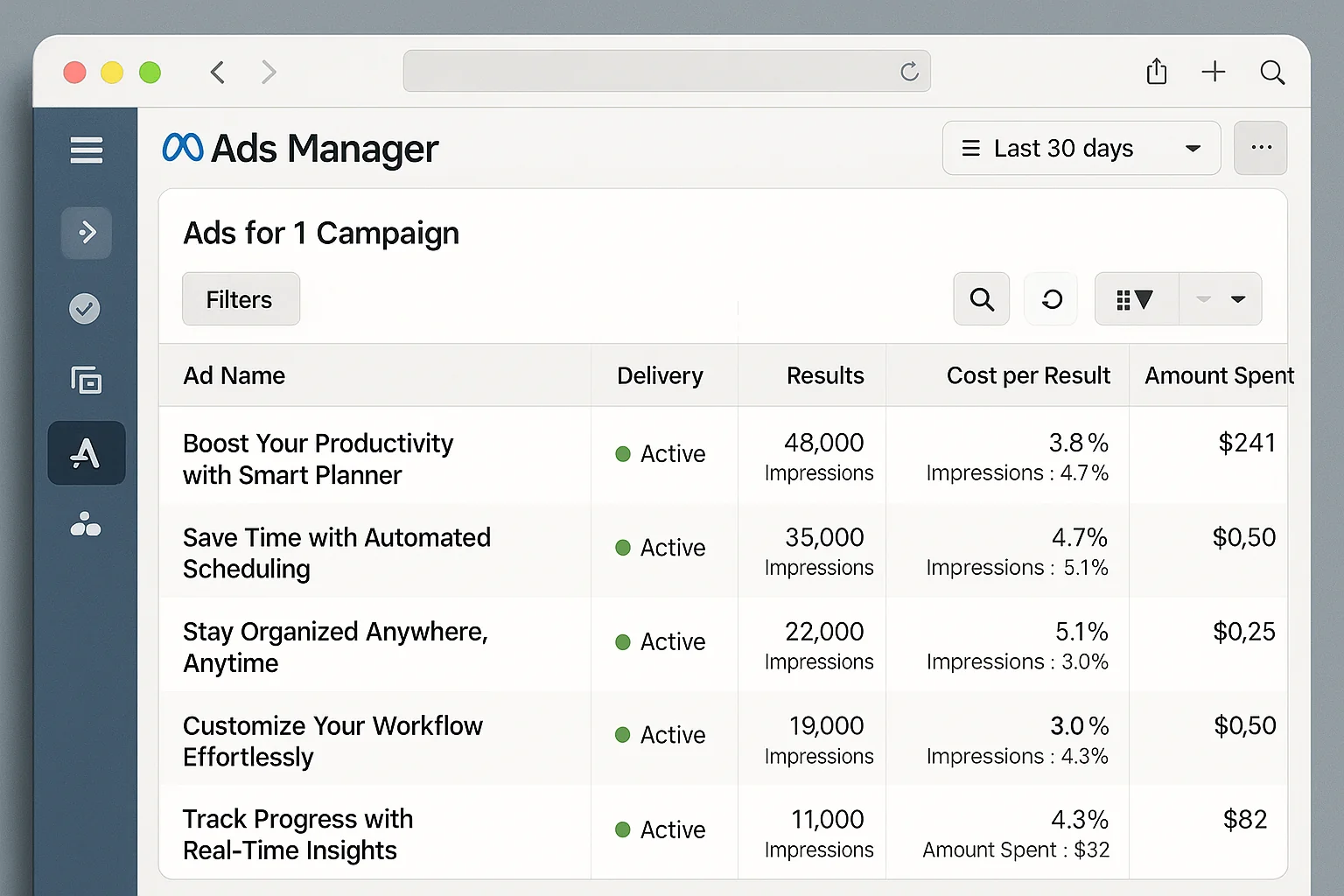
Each value proposition will resonate with a different segment of your audience. Andromeda will sort them.
The takeaway: These 7 approaches give Andromeda genuinely different creative to work with. Combine multiple approaches in each ad (format + visual concept + text angle + value prop) for maximum diversity across your account.
Why Quality Beats Volume EVERY. SINGLE. TIME.
Here is where most “creative diversification” advice goes off the rails.
Advertisers hear “you need 20-30 unique concepts per month” and immediately prioritize output speed over output quality. The result is a flood of mediocre, forgettable ads that check the “diversity” box on paper but fail to convert.
Diverse creative without quality control does not guarantee results.
A single brilliant static image that stops the scroll will outperform ten generic stock-photo variations EVERY time. One well-produced 15-second video with a killer hook will beat five rushed, poorly-lit UGC clips.
The math is straightforward. If you have budget for 10 creative assets per month, you will get better results from 7 high-quality, genuinely diverse pieces than from 10 rushed variations of the same concept.
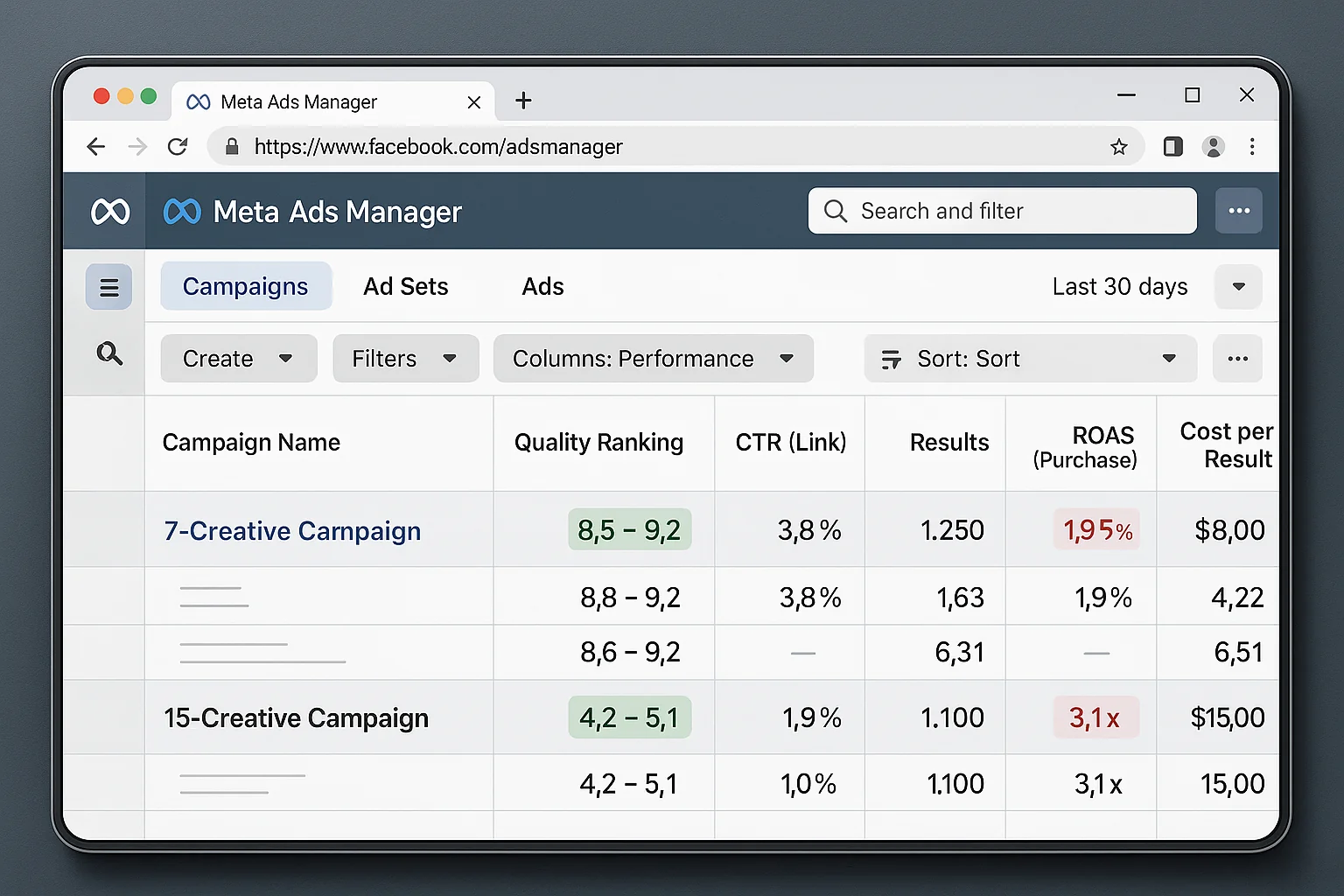
Here is how to think about the quality-volume balance:
Minimum quality bar for every creative: - The hook (first 3 seconds of video, or the primary visual of a static) is genuinely attention-grabbing - The value proposition is clear within 5 seconds - The visual quality meets platform standards (no pixelated images, no badly-lit video) - The text is free of errors and speaks directly to a specific persona
When to add MORE creative: - Your existing high-quality creative has been running for 2+ weeks - Frequency metrics show the same users are seeing the same ads repeatedly - You have a new angle, format, or persona to test (not just a new color variant)
When to STOP adding creative: - You are recycling the same concept with surface-level changes - Your team is rushing to hit a production quota at the expense of craft - New ads are performing worse than your existing top performers
The advertisers getting the best results from Andromeda are producing fewer, better, MORE DISTINCT creative assets. They are investing in genuine creative strategy over creative volume.
The takeaway: Volume without quality is waste. Set a minimum quality bar for every asset, and only add new creative when it brings a genuinely new angle to your account.
How to Audit and Diversify Your Creative in 5 Steps
Here is how to put this into practice today.
Step 1: Pull every active ad in your account and lay them out in a grid.
Open Ads Manager, filter to active ads, and screenshot each one. Arrange them side by side. This visual audit reveals similarity patterns you miss when reviewing ads individually.
Step 2: Score each ad across the 4 pillars.
For each ad, note: (1) format type, (2) visual concept, (3) text angle, (4) target persona. If you see the same score repeating across multiple ads, you have found your diversity gap.
Step 3: Identify your missing combinations.
Create a simple matrix with your personas across the top and your format types down the side. Mark which combinations you already have. The empty cells are your next creative briefs.
Step 4: Build 3-5 new assets that fill your biggest gaps.
Focus on the empty cells from step 3. Prioritize combinations that pair an underserved persona with a format you have not tried for them yet. Aim for GENUINELY different creative, not cosmetic tweaks to existing assets.
Step 5: Monitor for 7-14 days, then repeat.
Give Andromeda time to learn and optimize delivery. After two weeks, check which new assets are performing. Double down on what works. Replace what does not. Run the audit again.
This is not a one-time exercise. Creative diversification is an ongoing practice. Your audience evolves. Platform trends shift. New formats emerge. The advertisers who build this audit cycle into their monthly workflow will consistently outperform those who just “make more ads.”
The takeaway: Audit your current creative across all 4 pillars, identify the gaps, then fill them with high-quality assets that bring genuine diversity. Repeat monthly.
Now go audit your ad account. The gaps are already there. Fill them.